
Color TPU Paint Protection Film in South Florida: Style & Protection
An ArmorXcell guide to color PPF, vehicle wrapping, installation quality, durability, and ownership costs in South Florida.
Vehicle wrapping has changed. For years, drivers wanting a different color without repainting their cars primarily chose vinyl wraps. Today, color thermoplastic polyurethane (TPU) paint protection film offers another possibility: changing a vehicle’s appearance while adding a protective layer over its original paint.
But is color TPU PPF worth the extra cost? Does it really last longer than vinyl? And what should vehicle owners expect when their cars spend years exposed to South Florida’s sun, rain, humidity, and everyday road conditions?
These questions matter in Coral Springs, Boca Raton, Fort Lauderdale, Hollywood, Hallandale Beach, Miami, and throughout Broward, Palm Beach, and Miami-Dade counties.
ArmorXcell, based in Coral Springs, Florida, supplies automotive protection films, including color TPU paint protection film. Our approach is to examine the materials, their limitations, and the practical factors that determine whether a film is suitable for a particular vehicle.
This guide examines what manufacturers publish, what local installation businesses offer, and what vehicle owners themselves are saying.
1. South Florida Is a Demanding Environment for Vehicle Wraps
A vehicle wrap in South Florida faces a different ownership environment from one installed on a car that spends most of its life in a climate-controlled garage.
Consider a typical daily-driven vehicle parked outside at an office in Fort Lauderdale or an apartment complex in Coral Springs. Its horizontal surfaces receive prolonged sunlight. Afternoon rain, road contamination, bird droppings, insects, and repeated washing create additional maintenance demands.
South Florida’s warm, wet climate is well documented by the National Weather Service’s regional climate records.
For a vehicle wrap, the most important exposure factors include:
- Sunlight and UV exposure: Can contribute to color changes, surface aging, and degradation of susceptible film components.
- Heat: Elevated surface temperatures and repeated temperature changes can affect film behavior, particularly around stretched areas and edges.
- Rain and moisture: Increase the importance of sound installation, drainage, and appropriate cleaning.
- Road debris: Creates a need for genuine physical protection, particularly on bumpers, hoods, mirrors, and rocker panels.
- Outdoor parking: Can expose a film to more cumulative environmental stress than occasional weekend driving.
The important distinction is that these conditions do not affect every film equally.
Different materials, adhesives, pigments, topcoats, and manufacturing processes can produce substantially different results. Even two films marketed as TPU PPF may have different durability characteristics.
That is why choosing a film based only on color, appearance, or an advertised warranty period is insufficient.
2. What Is Color TPU Paint Protection Film?
Traditional paint protection film is commonly a transparent polymer film applied over automotive paint to reduce damage from minor road debris and surface abrasion.
Color TPU PPF extends this concept by incorporating a colored finish into a protective film system.
A typical color PPF construction may include a protective topcoat, a colored TPU-based film structure, pressure-sensitive adhesive, and a removable release liner. The exact construction depends on the manufacturer.
TPU is valued in automotive protection applications for its flexibility, toughness, and ability to conform to curved surfaces when formulated and installed appropriately.
However, TPU is a material category, not a guarantee of performance.
Actual resistance to discoloration, staining, scratching, and weathering depends on the complete film system.
For example, XPEL’s COLOR PPF product information describes an approximately 8-mil protective film, compared with the thinner vinyl products referenced in its comparison. These are specifications for XPEL’s product, not universal specifications for every color TPU film.
When comparing brands, buyers should request technical data for the exact film being offered.
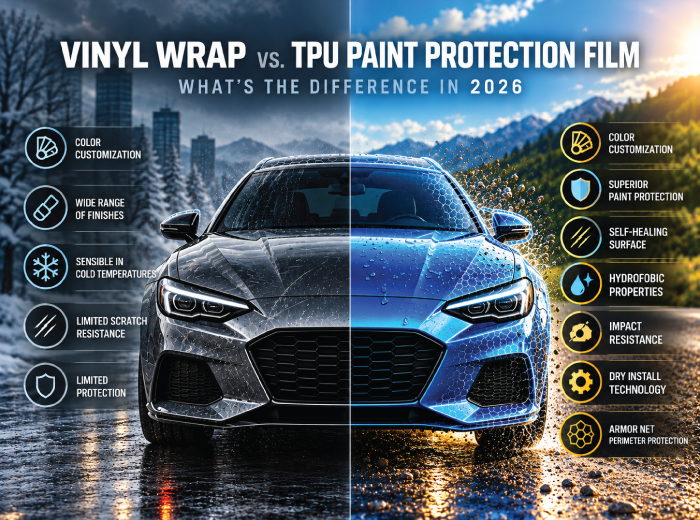
3. Color TPU PPF vs. Traditional Vinyl Wrap: What Really Changes?
Both products can dramatically transform a vehicle’s appearance, but they are designed with different priorities.
| Comparison | Color TPU PPF | Traditional color-change vinyl |
|---|---|---|
| Primary purpose | Color change and paint protection | Primarily appearance and color change |
| Typical base material | Thermoplastic polyurethane | Commonly PVC-based vinyl |
| Film thickness | Often thicker | Generally thinner |
| Protection from road debris | Designed to offer greater protection | Limited physical protection |
| Complex body contours | May require specialized PPF techniques | Often easier to conform, depending on film |
| Finish choices | Gloss, satin, matte, metallic and specialty colors | Extensive colors, textures and finishes |
| Material and installation cost | Usually higher | Usually lower |
| Long-term performance | Depends on the specific film and conditions | Depends on film grade and conditions |
This is not a comparison between all possible TPU and vinyl products. It describes the general differences between conventional automotive color-change vinyl and protective color TPU films.
The key point is that a conventional vinyl wrap is primarily an appearance product. Although it creates a physical layer over paint, it should not be assumed to provide the same resistance to road debris as a dedicated PPF.
Color TPU PPF attempts to combine both functions.
That combination may be especially attractive for vehicles whose owners want a substantial color change but also want to preserve the original painted surfaces.
Nevertheless, neither material makes a vehicle immune to rock chips, deep scratches, collisions, or environmental damage.
4. A Real South Florida Question: Will a Color Wrap Last Two Years or Six?
In an October 13, 2026 discussion on Reddit’s r/CarWraps community, a South Florida Porsche 997 Turbo owner described contacting six local wrapping shops and receiving conflicting advice about color wraps and colored PPF.
The owner’s central concern was straightforward: would a film costing thousands of dollars still look good after several years in Florida?
Read the original South Florida Porsche discussion on Reddit.
Responses varied considerably.
Some commenters favored premium cast vinyl. Others recommended color PPF for its protective characteristics. Several emphasized that garage storage, installer skill, product quality, and maintenance were more important than broad claims about film lifespan.
One participant reported having colored PPF on a vehicle for four years with satisfactory results. Another advised a much more conservative replacement schedule.
These statements are individual experiences and opinions, not controlled durability studies. However, they reveal something important about the market: customers are struggling to distinguish product claims from realistic expectations.
Why lifespan claims are difficult to compare
A manufacturer may advertise a warranty of five, seven, or ten years. But a warranty is not necessarily a prediction that a film will look new for the entire period.
A warranty may cover specific defects such as cracking, bubbling, or excessive yellowing while excluding other changes, installation defects, improper maintenance, or environmental damage.
The actual outcome depends on factors such as:
- Whether the car is garaged or parked outside
- The amount of direct sunlight received
- Film formulation and topcoat quality
- Color and finish
- Installation quality and stretched areas
- Cleaning products and maintenance
- Whether the original paint is sound
- The manufacturer’s specific warranty exclusions
For comparison, XPEL states that its COLOR PPF can last up to ten years with proper care. That is XPEL’s product-specific claim; it should not be applied automatically to another manufacturer’s film.
At ArmorXcell, we believe durability discussions should begin with product-specific documentation and realistic usage conditions, not a universal lifespan promise.
5. Why Installation Quality Can Matter as Much as Film Quality
Even an excellent film can produce disappointing results if it is installed incorrectly.
Color PPF installation requires more than simply placing colored material over a painted panel.
The installer must manage surface preparation, film tension, curves, corners, panel gaps, edge finishing, and adhesive behavior.
Color coverage also creates challenges that may be less noticeable with transparent PPF.
For example, a blue film installed over a white vehicle can leave visible white areas around panel edges, door openings, or complex recesses unless coverage is carefully planned.
What can go wrong?
Common concerns include:
Excessive stretching. Stretching may change film thickness, surface appearance, and local mechanical stress. Some finishes are particularly sensitive to distortion.
Poor edge finishing. Edges that are insufficiently secured can collect dirt or begin lifting.
Contamination beneath the film. Dust and debris can create visible defects, especially on dark gloss finishes.
Inadequate paint preparation. Contamination, deteriorated clearcoat, and prior repairs can affect adhesion and future removal.
Improper post-installation care. Aggressive pressure washing near edges may cause lifting.
The 3M Paint Protection Film Installation Guidelines discuss installation temperatures, washing precautions, pressure-washing risks, and maintenance. These instructions apply to the relevant 3M products, but they illustrate why professional installation procedures matter.
Questions to ask a South Florida installer
Before accepting a quotation, ask:
- Which exact manufacturer and film series will be installed?
- Is the product color TPU PPF or conventional vinyl?
- Can the installer show physical film samples?
- Will edges be wrapped, and which areas may remain exposed?
- Are door jambs, mirrors, spoilers, and complex trim included?
- What preparation and paint correction are included?
- What separate warranties cover the film and installation?
- What is the recommended inspection and maintenance schedule?
- How will the film eventually be removed?
A reputable installer should be able to explain the limits of the chosen film rather than promise a flawless or permanent result.
6. What Does the South Florida PPF Market Actually Offer?
South Florida already has an established vehicle protection and customization industry.
A review of publicly advertised services shows that customers can find clear PPF, colored PPF, vinyl wraps, ceramic coatings, and combinations of these products.
For example, Auto SuperShield in Boca Raton advertises color-wrap PPF and notes that cost and service life depend on vehicle size, coverage, color, exposure, and maintenance.
Wrap Department advertises South Florida color PPF installation with gloss, matte, and satin finishes, alongside clear PPF services.
SSF Detail in Boca Raton publishes PPF coverage packages, including full-front, track-oriented, and full-body options.
These businesses illustrate the range of services available locally. They are independent businesses, not ArmorXcell installation partners or endorsements.
Why this matters for customers
The local market is not limited to one type of vehicle owner.
Different buyers have different priorities:
Daily drivers: Often prioritize appearance, maintenance, cost, and protection against ordinary road debris.
Luxury and performance vehicles: Owners may place greater emphasis on preserving original paint, detailed edge finishing, and premium appearance.
SUVs and family vehicles: Large surface areas, complex bumpers, and substantial material requirements can affect installation cost.
Collectors and weekend vehicles: Garage storage and limited mileage may change the importance of weather exposure compared with daily-use vehicles.
A film that makes sense for a garage-kept Porsche may not be the best economic choice for an older commuter vehicle parked outdoors every day.
The correct recommendation depends on the vehicle and its intended use.
7. How Much Does Color TPU PPF Cost in South Florida?
Cost is one of the biggest differences between color PPF and traditional vinyl wrapping.
A full color PPF installation typically requires more expensive material and can involve additional labor, particularly around complex body panels.
Published local prices provide useful reference points, although they are not a substitute for an individual quotation.
For example, Wrap Department advertises full-vehicle color PPF installation starting at $4,000 plus tax.
Another South Florida provider, Wrap Trap, advertises a color PPF range of approximately $4,500–$8,500 on its Boca Raton service page.
These are advertised starting prices or estimates from individual providers, not a verified regional average. The final price may be substantially different.
Why prices vary
A full-size SUV usually requires more material than a compact coupe. A vehicle with complicated bumpers, sharp body lines, or extensive trim may also require more installation time.
Other cost factors include:
- Film brand, construction, and finish
- Vehicle size and panel complexity
- Existing paint condition
- Removal of previous wraps
- Edge wrapping and door-jamb coverage
- Paint correction and preparation
- Installation warranty and aftercare
Comparing quotations without comparing the film and coverage is misleading.
Is the additional investment justified?
Consider two owners.
One wants a temporary color change for a vehicle they expect to sell in eighteen months. A premium vinyl wrap might meet that goal at a lower initial cost.
Another intends to keep a valuable vehicle for several years, wants a different color, and also wants meaningful paint protection. Color TPU PPF may be worth considering.
The economic decision should account for the initial price, realistic service life, maintenance, removal, and potential replacement.
The cheapest installation is not necessarily the least expensive over the full ownership period.
8. Color PPF Is Not Always Better Than Vinyl
It is important to acknowledge situations where vinyl remains a reasonable choice.
Traditional cast vinyl can offer an extensive range of colors and special finishes. It may also be more suitable for certain intricate shapes, commercial graphics, short-term designs, or budget-conscious projects.
Color TPU PPF has its own limitations.
Because protective films are generally thicker, installation on complicated contours can be more demanding. A colored film may not cover deep recesses as easily as a thinner vinyl product.
There can also be significant differences between wet-application and dry-application TPU systems.
These are not interchangeable installation methods.
A film engineered for wet installation should not be assumed suitable for dry installation, and vice versa. Installers must follow the instructions for the exact product.
Color matching is another consideration. Product photographs and digital renderings cannot reproduce every difference in gloss, metallic effect, texture, or lighting.
Physical samples viewed in natural sunlight are essential before choosing an expensive full-vehicle finish.
9. Gloss, Satin, Matte, and Metallic Finishes: Choosing for Florida
Color TPU PPF is available in several visual styles, each producing a different appearance.
Gloss finishes
Gloss PPF is designed to create a reflective, paint-like appearance. It can work particularly well with vibrant colors and vehicles with pronounced body lines.
However, a high-gloss finish also makes certain surface imperfections more noticeable.
Satin finishes
Satin finishes provide a softer reflection than traditional gloss, emphasizing vehicle shape without a fully matte appearance.
They are popular for understated metallic and performance-inspired colors.
Matte finishes
Matte films create a low-reflection appearance. Their maintenance requirements may differ from those of gloss films, particularly regarding polishing products and stain removal.
Owners should use products specifically approved for the film.
Metallic and specialty finishes
Metallic, pearlescent, and color-shifting films can change appearance considerably with viewing angle and sunlight.
These finishes should always be evaluated using real samples rather than relying only on online images.
ArmorXcell color examples
Our developing TPU PPF collection includes:
- Satin Liquid Metallic Cobalt Blue — GTPU-0236: A saturated blue metallic finish.
- Glossy McLaren Orange — GTPU-0169: A bright orange gloss finish.
- Satin Liquid Metallic Antique Copper — GTPU-0055: A warm metallic copper appearance.
- Satin Extreme Grey — GTPU-0205: A restrained satin grey.
- Matte Battle Green — GTPU-0146: A muted green matte finish.
- Gloss Iridescent Fluorescent Yellow — GTPU-0386: A high-visibility specialty yellow finish.
These examples describe appearance and product identification, not independently verified durability or protection ratings.
Explore the ArmorXcell Color TPU Paint Protection Film collection to compare available colors and finishes.
10. How Should You Maintain a Wrapped Car in South Florida?
Maintenance matters whether a vehicle uses vinyl or color TPU PPF.
A practical routine should include regular washing, prompt removal of contaminants, and periodic inspection of film edges.
Washing
Use a cleaning product approved by the film manufacturer and a clean, soft wash mitt or appropriate touchless washing method.
Avoid abrasive polishing products unless the manufacturer explicitly permits them.
Pressure washing
High-pressure water directed at film edges can contribute to lifting. Maintain the distance, angle, and pressure recommended by the film supplier.
Bird droppings and insect residue
Remove contamination promptly using an approved cleaner. Prolonged contact can stain or damage some finishes.
Outdoor parking
Covered parking can reduce direct environmental exposure, although it does not eliminate the need for cleaning and inspection.
Ceramic coatings
Some films can be treated with compatible ceramic coatings. However, a ceramic coating is not a substitute for physical paint protection, and it should not be assumed to extend a film’s life by a specific number of years.
Compatibility should be confirmed with the film manufacturer.
For additional guidance, consult 3M’s automotive film care recommendations. Always prioritize instructions for the film actually installed.
11. What Happens When Color PPF Needs to Be Removed?
One advantage of wrapping is that a vehicle’s appearance can be changed without permanently repainting the original surface.
However, removability should not be interpreted as a guarantee that removal is risk-free.
Adhesive aging, film condition, previous paint repairs, weak clearcoat, and removal techniques can affect the outcome.
Factory paint in sound condition generally offers a more predictable starting point than deteriorated or poorly repaired paint.
A professional installer should evaluate the existing finish before installation and explain potential removal risks.
Owners should also retain their installation records, film identification, and warranty documents.
For a vehicle expected to remain wrapped for many years, planning for eventual removal is part of responsible ownership.
12. What South Florida Vehicle Owners Are Saying
Online automotive communities provide useful insight into questions that may not be answered clearly in promotional material.
A Florida Lexus owner considering a wrap asked whether the local heat would make wrapping an impractical investment.
A separate discussion about real-world vinyl wrap longevity highlighted differences between garaged vehicles and cars regularly parked in the sun.
Another discussion comparing color PPF products raised concerns about installation complexity, color coverage, and the additional cost of protective film.
These discussions should not be treated as controlled testing or proof of a particular product’s lifespan.
They do, however, identify recurring customer concerns:
- Is the extra cost worthwhile?
- How does outdoor parking affect appearance?
- How can buyers distinguish film quality?
- Will the installer achieve complete color coverage?
- What happens when the film needs replacement?
These are precisely the questions a knowledgeable supplier and installer should be prepared to answer.
13. How to Evaluate a Color TPU PPF Supplier
The number of brands available online can make product selection difficult.
A premium-looking website or expensive retail price does not necessarily establish superior film quality.
For installers and buyers comparing color TPU PPF products, we recommend requesting:
Technical specifications. Film thickness, construction, adhesive information, and relevant performance measurements.
Product identification. Exact series and color codes, rather than generic descriptions.
Warranty documentation. Written coverage terms, exclusions, and claim procedures.
Installation instructions. Approved wet or dry methods, temperature recommendations, stretching limits, and edge-finishing guidance.
Physical samples. Actual material samples for color and finish evaluation.
Performance evidence. Test reports relevant to the claims being made, ideally identifying the test method and specific film tested.
Supply consistency. Confidence that replacement material will match the original product.
Manufacturers such as XPEL publish technical data sheets for their color PPF lines. This provides an example of the type of product-specific information buyers should seek.
At ArmorXcell, we aim to make product identification, material information, and practical selection guidance central to our approach.
We also recognize that supplier statements and laboratory results must be distinguished from verified long-term performance under actual South Florida conditions.
14. ArmorXcell: A South Florida-Based Film Supplier
ArmorXcell is based in Coral Springs, Florida, with a focus on automotive surface protection materials.
Our product development includes color TPU paint protection films and exterior automotive window protection films.
For the color TPU PPF category, our objective is to provide a broad range of contemporary finishes while helping installers and vehicle owners understand the differences between material types, installation methods, and performance claims.
We are a film supplier, not an installation shop. Professional application should be carried out by a qualified installer familiar with the particular film system.
Our local market focus includes Coral Springs, Parkland, Coconut Creek, Deerfield Beach, Boca Raton, Pompano Beach, Fort Lauderdale, Hollywood, Hallandale Beach, Aventura, and Miami.
Rather than relying solely on broad promises about protection or longevity, we believe customers benefit from clear specifications, practical installation information, and transparent discussion of limitations.
15. Final Verdict: Is Color TPU PPF Worth It in South Florida?
For a vehicle owner who wants only a short-term appearance change, high-quality cast vinyl may remain a practical option.
For someone seeking both a color transformation and meaningful protection for the original paint, color TPU PPF deserves serious consideration.
The decision should not depend on claims that every TPU film lasts ten years or that all vinyl wraps fail after two years. Neither statement is reliable as a universal rule.
The better question is: Which specific film, installed by which professional, under which ownership conditions, provides the best overall value?
In South Florida, that means accounting for sunlight, outdoor parking, vehicle use, maintenance, installation quality, and future removal.
Color TPU PPF offers an exciting combination of automotive styling and protective functionality. But the best results come from informed product selection, realistic expectations, and professional installation.
Explore ArmorXcell Color TPU Paint Protection Films
Discover gloss, satin, matte, metallic, and specialty color finishes in the ArmorXcell TPU PPF collection.
Whether you’re a vehicle owner researching your next color change or a professional installer comparing film options, explore our product range and contact ArmorXcell for product information and availability.
Sources and Further Reading
- National Weather Service — South Florida Climate
- XPEL — COLOR Paint Protection Film
- XPEL — Technical Product Specifications
- 3M — Paint Protection Film Installation Guidelines (PDF)
- 3M — Automotive Film Care and Support
- Reddit — South Florida Porsche Owner Discusses Color PPF
- Reddit — Florida Lexus Owner Discusses Wrapping and Heat
- Reddit — Real-World Vinyl Wrap Longevity
- Auto SuperShield — Color PPF in Boca Raton
- Wrap Department — South Florida PPF Services
Research reviewed October 2026. Product specifications, prices, warranties, and availability may change. Third-party businesses and customer discussions are cited for context and do not represent ArmorXcell endorsements or partnerships.