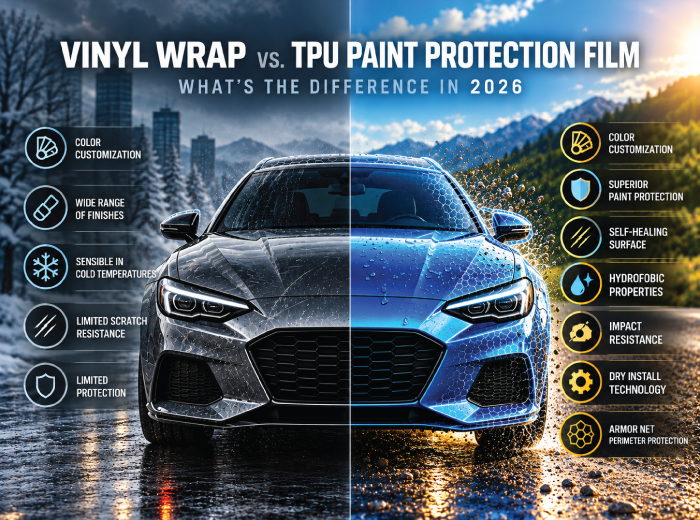

TPU Paint Protection Film vs. Ceramic Coating: What Actually Protects Your Car?
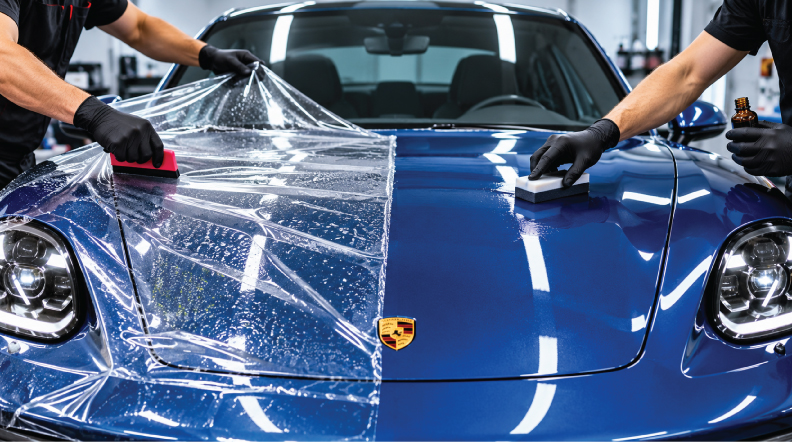
An evidence-based South Florida guide to physical paint protection, ceramic coatings, installation costs, and the difference between appearance and damage resistance.
Introduction: Two Products, Two Very Different Definitions of Protection
If you search for automotive paint protection in South Florida, you will encounter two widely advertised solutions: ceramic coatings and paint protection film (PPF).
Both promise to help keep vehicles looking newer. Both can cost thousands of dollars when professionally installed. Both are marketed as advanced automotive protection technologies.
But they do not protect paint in the same way.
Ceramic coating primarily changes the chemical and surface properties of automotive clearcoat. TPU paint protection film creates an additional physical layer above the paint.
Understanding this distinction is essential before spending money on either service.
At ArmorXcell, based in Coral Springs, Florida, we believe automotive protection should be explained through material properties and practical results—not marketing terminology.
1. What Is Ceramic Coating?
Automotive ceramic coatings are thin surface treatments commonly based on silicon-containing compounds.
After appropriate preparation and application, they form a durable coating over the vehicle’s clearcoat.
Their main purposes are to improve water repellency, reduce adhesion of some contaminants, simplify washing, and maintain an attractive surface finish.
A professionally applied ceramic coating may provide better durability than conventional wax, but its effectiveness depends on the product, preparation, application, and maintenance.
What does the coating actually protect against?
Ceramic coatings can offer resistance to certain chemical contaminants and make dirt, insects, and bird droppings easier to remove before they cause damage.
However, they do not eliminate the possibility of etching, staining, oxidation, or scratches.
And they cannot meaningfully absorb the impact energy of a stone striking a vehicle at highway speed.
2. The Physical Barrier Question
Consider what happens when a small stone strikes a painted hood.
The impact transfers energy into a very small contact area. If the resulting stress exceeds the paint system’s resistance, the clearcoat or paint can crack or chip.
A ceramic coating is far too thin to provide substantial cushioning or impact-energy absorption.
A TPU paint protection film, by contrast, adds a relatively thick, flexible polymer layer.
The film can deform under some impacts, distribute forces, and sacrifice part of its own structure before damage reaches the underlying paint.
That is the fundamental mechanical advantage of PPF.
It does not mean PPF is indestructible. A sufficiently severe impact can penetrate the film and damage the paint beneath it.
But the physical protection mechanism is real and materially different from that of ceramic coating.
3. What Does 9H Ceramic Hardness Mean?
One of the most widely advertised ceramic coating claims is 9H hardness.
Consumers sometimes interpret this as evidence that the coating is almost impossible to scratch.
However, 9H commonly refers to pencil hardness, which measures resistance to marking under a defined test procedure.
It is not equivalent to the Mohs mineral hardness scale, nor does it establish resistance to stone impacts or deep scratches.
A thin, hard coating can still be damaged by abrasive particles trapped in a washing mitt or car-wash brush.
Hardness alone does not establish impact resistance.
Consumers should therefore ask what testing was performed and whether the result demonstrates a benefit relevant to everyday vehicle use.
4. TPU PPF vs. Ceramic Coating: Direct Comparison
| Feature | Ceramic coating | TPU PPF |
|---|---|---|
| Physical barrier | Very thin coating | Substantial polymer film |
| Water repellency | Often excellent | Depends on film topcoat |
| Gloss improvement | Often significant | Depends on finish |
| Chemical resistance | Product-dependent | Product-dependent |
| Rock-chip resistance | Negligible | Designed for impact protection |
| Light scratch protection | Limited | Film shields underlying paint |
| Deep scratch protection | Minimal | Limited by damage severity |
| Paint preservation | Primarily environmental | Mechanical and environmental |
| Maintenance | Still required | Still required |
| Color transformation | Generally no | Yes, with color TPU PPF |
The important difference is not whether one product is universally better.
It is which problem the customer wants to solve.
5. Professional Ceramic Coating Is Not Necessarily Cheap
Ceramic coating is sometimes presented as an inexpensive alternative to PPF.
Basic consumer-applied coatings can be relatively affordable. Professional ceramic coating services are a different matter.
A professional installation may include washing, chemical decontamination, machine polishing, paint correction, surface preparation, coating application, and curing.
The labor required to prepare the paint can account for a substantial portion of the final price.
Published Florida pricing illustrates the difference.
Florida Auto Ceramics advertises full-car ceramic coating at approximately $999–$1,199 and full-front PPF at $1,800–$2,400.
DShine Details publishes South Florida ceramic coating price ranges extending to approximately $2,500 for higher-tier packages.
These figures are provider advertisements, not independently calculated regional averages.
What are you actually paying for?
With ceramic coating, much of the value may come from professional surface preparation, paint correction, appearance enhancement, and easier future cleaning.
With PPF, the customer pays for protective film material, preparation, complex installation work, and physical coverage of painted surfaces.
These are different deliverables, even when the prices overlap.
6. Can Ceramic Coating Prevent Washing Scratches?
A ceramic coating may reduce the adhesion of dirt and make washing easier.
This can indirectly reduce some scratching risks because contaminants may be removed with less aggressive cleaning.
However, a hard abrasive particle trapped between a brush and the paint can still scratch a coated surface.
Automatic brush car washes can create visible swirl marks even on coated vehicles.
A TPU PPF adds material above the paint, meaning some scratches affect the replaceable film rather than the original clearcoat.
Certain PPF products also incorporate self-healing topcoats that can reduce the visibility of light surface marks under appropriate conditions.
Self-healing is product-specific and does not repair deep cuts or damaged paint.
7. What About UV Protection?
Automotive factory paint systems already incorporate technologies intended to resist weathering and ultraviolet exposure.
Ceramic coating manufacturers frequently advertise additional UV protection, but the strength of this claim depends on the actual product and supporting test data.
Without measurements demonstrating how much relevant UV radiation is attenuated by a particular coating, it is difficult to quantify the additional benefit.
The same standard should apply to PPF.
A claim of UV resistance should identify what was tested: the film’s own weathering resistance, UV transmission, protection of the underlying paint, or some combination.
These are not identical properties.
8. South Florida: Which Protection Matters Most?
South Florida drivers face strong sunlight, frequent rain, road contamination, and substantial highway traffic.
For a vehicle regularly traveling on I-95, Florida’s Turnpike, or the Sawgrass Expressway, road debris may be a more immediate threat to front-facing paint than the contaminants addressed by ceramic coating.
A vehicle parked outdoors for extended periods may place greater value on cleaning convenience and environmental resistance.
This suggests different approaches for different owners.
A commuter concerned about stone chips may prioritize PPF on the hood, bumper, mirrors, and other impact zones.
A garage-kept show vehicle may prioritize paint correction and appearance maintenance.
An owner wanting a new exterior color may consider color TPU PPF, which combines visual transformation with protective film coverage.
No single treatment is necessary for every vehicle.
9. What Do Vehicle Owners Think?
In a July 2026 Reddit discussion about PPF and ceramic coating, a BMW X7 owner compared approximately $2,550 for full-front PPF with another $1,200 for ceramic coating.
The owner questioned whether the expense was justified compared with repairing occasional damage.
That is a reasonable economic question.
In another automotive detailing discussion, owners described ceramic coatings primarily as a maintenance benefit and PPF as protection against rock chips.
Some felt PPF was worthwhile for their vehicles. Others preferred to accept ordinary wear rather than pay thousands of dollars upfront.
These are personal experiences, not controlled performance tests. But they demonstrate that customers increasingly want to understand the actual value of protection services.
10. Can Ceramic Coating Be Applied Over TPU PPF?
Yes, some ceramic coatings are specifically formulated and approved for use over compatible paint protection films.
This combination can provide physical protection from the PPF alongside the surface-maintenance characteristics of ceramic coating.
However, many modern PPF products already include advanced topcoats with hydrophobic and stain-resistant properties.
Adding ceramic coating may therefore offer a smaller incremental benefit than advertising suggests.
Before purchasing an additional treatment, customers should ask:
- Does the installed PPF already have a hydrophobic topcoat?
- Is the proposed ceramic coating compatible with that film?
- What measurable additional benefit does the coating provide?
- Will it affect the film manufacturer’s warranty?
- Is the additional cost justified by easier maintenance?
A ceramic coating should not be applied beneath PPF without following the film manufacturer’s preparation requirements, because it may interfere with adhesive bonding.
11. Does Ceramic Coating Make Financial Sense?
The answer depends on what the owner values.
If the objective is easier washing, attractive gloss, and improved resistance to some contaminants, professional ceramic coating may be worthwhile.
If the objective is preventing stone chips and limiting mechanical damage to the original paint, ceramic coating is not a substitute for PPF.
If the objective is both appearance and physical protection, TPU PPF may offer a more appropriate solution.
However, full-body PPF can be expensive. For some ordinary vehicles, accepting minor wear and paying for occasional paint correction or touch-up may be the more economical decision.
There is no guarantee that either treatment will recover its installation cost through higher resale value.
12. The ArmorXcell Perspective
At ArmorXcell, we focus on automotive protection films because they provide a physical layer between external hazards and the vehicle’s original surfaces.
Our TPU PPF collection includes color finishes designed for vehicle appearance customization alongside the protective function of film.
We recognize that ceramic coatings have legitimate uses, particularly for cleaning convenience and surface maintenance.
But hydrophobic behavior, gloss, and chemical resistance should not be confused with impact protection.
Customers deserve to understand the difference before choosing a product or installation package.
For South Florida vehicle owners, the best approach begins by identifying the actual threat: road debris, surface abrasion, environmental contamination, or simply the desire for a different appearance.
Explore Color TPU Paint Protection Films
Discover ArmorXcell’s gloss, satin, matte, metallic, and specialty color TPU PPF collection.
Based in Coral Springs, Florida, ArmorXcell supplies automotive protection films and product information for vehicle owners and professional installers.
Sources and Further Reading
- Florida Auto Ceramics — Ceramic Coating and PPF Pricing
- DShine Details — South Florida Detailing Prices
- Auto SuperShield — PPF vs. Ceramic Coating in Florida
- Reddit — Is PPF + Ceramic Really Worth It?
- Reddit — Is PPF and Ceramic Coating Worth It?
- Reddit — Ceramic Coating or Paint Protection Film?
Pricing and product information reviewed October 2026. Published prices and product claims may change. Individual customer experiences do not establish universal performance results.