
ArmorXcell EPU-5090 Exterior Window Protection Film — 35% VLT
Advanced exterior protection for automotive side windows and panoramic glass roofs.
Automotive glass is constantly exposed to sunlight, ultraviolet radiation, airborne particles, road debris, rain, and changing temperatures. While conventional window tint is generally installed on the inside of the glass, ArmorXcell EPU-5090 takes a different approach: protection begins on the outside, before environmental exposure reaches the glass surface.
EPU-5090 combines a sophisticated exterior protective layer with solar-control properties and a refined, darker appearance. Designed for compatible automotive side windows and panoramic glass roofs, the film offers an additional line of defense while preserving the vehicle’s modern styling.
With 35% visible light transmission (VLT), EPU-5090 provides noticeable darkening without creating a completely opaque appearance.
Why Exterior Window Protection Matters
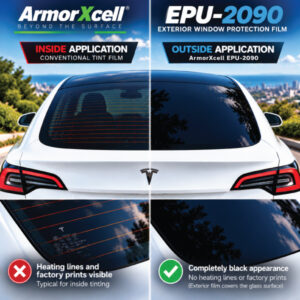
Traditional automotive window films primarily address sunlight, glare, privacy, and interior comfort. They are commonly applied to the interior glass surface, leaving the outside of the window directly exposed to environmental conditions.
ArmorXcell EPU-5090 is installed on the exterior surface of the glass, creating an additional protective layer between the environment and the underlying window.
This approach offers several potential advantages:
- An added sacrificial surface exposed to everyday environmental wear.
- Protection against minor surface scratches and light abrasion.
- UV rejection that helps limit ultraviolet transmission.
- Infrared rejection at specified wavelengths.
- A darker, more uniform appearance for compatible side windows and panoramic roofs.
- A protective film surface that can be replaced without necessarily replacing the underlying glass.
Exterior film protection does not make automotive glass unbreakable or eliminate the risk of chips, cracks, or impact damage. Its purpose is to provide an additional protective layer while contributing to the vehicle’s appearance and solar-control performance.
35% VLT — A Balance of Light and Appearance
Visible Light Transmission measures the percentage of visible light passing through a film under specified test conditions.
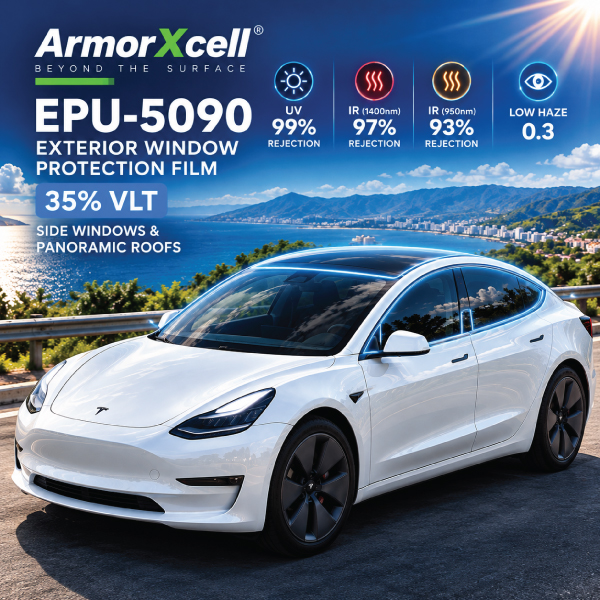
EPU-5090 has a manufacturer-reported VLT of 35%, meaning approximately 35% of visible light passes through the film itself.
This produces a distinctly darker appearance than clear protection film, making EPU-5090 an option for drivers seeking both exterior glass protection and a more refined visual finish.
The actual visible light transmission of the finished window depends on the combination of the original automotive glass and the applied film. Factory-tinted glass may produce a darker final result.
For this reason, EPU-5090 should be selected with consideration for visibility requirements and applicable vehicle window tint regulations.
Infrared Rejection — Understanding the Numbers
Infrared radiation is one component of solar energy that can contribute to heating inside a vehicle.
The EPU-5090 manufacturer reports the following infrared rejection performance:
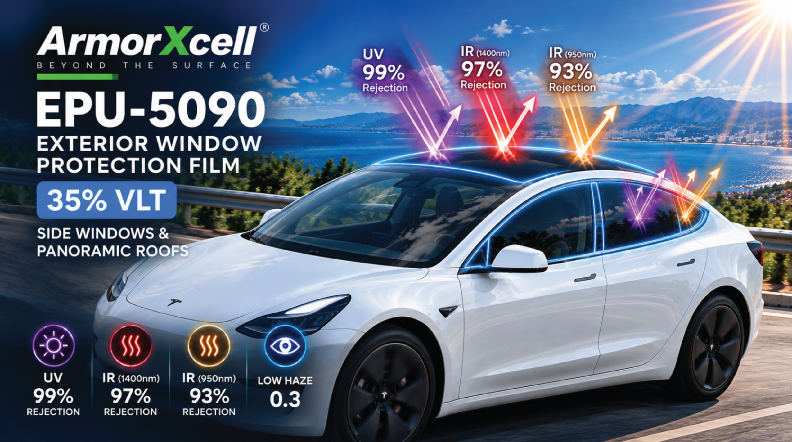
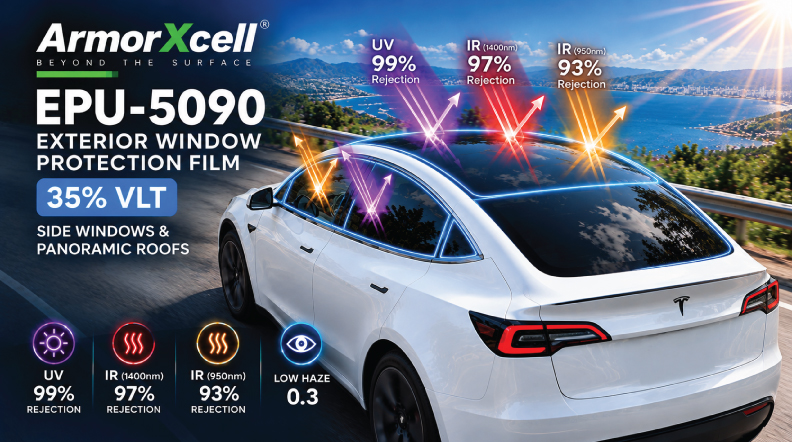
- 93% IR rejection at 950 nm
- 97% IR rejection at 1400 nm
These values describe the film’s reported performance at two specific infrared wavelengths.
They do not mean that the film rejects 93–97% of all solar heat. Total Solar Energy Rejected (TSER) measures a broader range of solar energy and is a separate performance characteristic.
Actual cabin temperature reduction depends on numerous factors, including vehicle design, glass area, solar exposure, factory glass properties, ventilation, and the complete optical characteristics of the installed film.
Nevertheless, wavelength-specific infrared rejection is a relevant feature when evaluating films designed to manage solar exposure.
99% UV Rejection — Additional Protection Against Sun Exposure
Ultraviolet radiation can contribute to the deterioration of certain interior materials, including upholstery, plastics, and decorative surfaces.
According to the manufacturer, EPU-5090 provides 99% UV rejection under its reported testing conditions.
Reducing ultraviolet transmission through treated glass can help limit UV exposure and contribute to the preservation of interior surfaces.
UV rejection should not be confused with total heat rejection. Ultraviolet, visible, and infrared radiation occupy different regions of the electromagnetic spectrum, and their effects should be evaluated separately.
Panoramic Glass Roof Protection
Modern panoramic roofs create an open, spacious cabin atmosphere, but their large glass surfaces are exposed to continuous sunlight and environmental wear.
Because panoramic roof glass is often expensive to replace, adding a protective film layer can be an attractive preventive measure.
EPU-5090 is intended for compatible panoramic roof applications where a darker glass appearance and exterior surface protection are desired.
Potential benefits include:
- Additional protection against minor surface abrasion.
- Reduced ultraviolet transmission through treated glass.
- Infrared rejection at the manufacturer’s specified wavelengths.
- A darker roof appearance that complements contemporary vehicle styling.
- A replaceable protective surface for compatible glass installations.
Film compatibility must be confirmed for the specific roof construction. Panoramic roofs may incorporate laminated glass, tempered glass, factory coatings, heating elements, or other technologies that affect installation suitability.
EPU-5090 is not a guarantee against roof cracking, breakage, or hail damage.
Exterior Side Window Protection
Side windows face different challenges from fixed panoramic glass.
In addition to sunlight and environmental exposure, movable side windows experience repeated contact with window seals, weatherstripping, and door mechanisms.
EPU-5090 is designed for exterior automotive glass applications, but installers must verify compatibility with each vehicle’s side window construction and operating mechanisms.
Professional evaluation is particularly important for windows that move into the door assembly, where repeated friction can affect exterior film edges and long-term durability.
The film’s 35% VLT may also be subject to restrictions depending on the window position and local regulations.
For a successful installation, the installer should assess both the vehicle’s glass configuration and the applicable legal requirements.
Self-Healing EPU Surface Technology
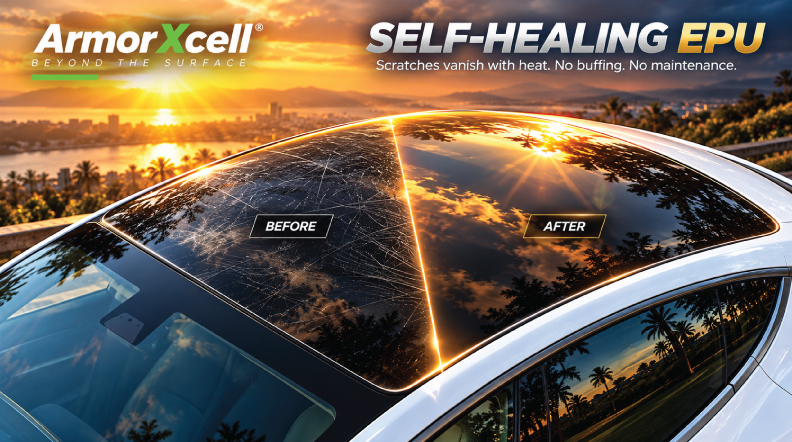
One of the distinguishing features promoted for this generation of EPU film is its ability to recover from certain minor surface scratches.
The manufacturer describes the material as scratch-resistant and capable of rapid scratch repair.
Self-healing technology is intended to help the film surface recover from some superficial marks, potentially assisted by warmth, depending on the severity of the scratch and the material’s properties.
This is particularly relevant for an exterior film that encounters cleaning, dust, and ordinary environmental contact.
However, self-healing does not mean that every scratch disappears. Deep cuts, punctures, damaged adhesive, and deformation extending beyond the recoverable surface layer may be permanent.
For customers, the practical advantage is a protective surface designed to maintain its appearance under suitable everyday conditions.
Optical Clarity and Haze
Optical quality is particularly important for automotive window applications.
Haze describes the scattering of transmitted light, which can affect the apparent clarity of a transparent material.
The manufacturer lists a haze value of 0.3 for EPU-5090.
Because the supplied specifications do not identify the test standard or measurement unit, this value is presented as manufacturer-reported information rather than an independently certified result.
Proper installation, clean glass preparation, and material compatibility are essential to achieving a satisfactory finished appearance.
EPU-5090 Technical Specifications
| Property | Manufacturer-Reported Specification |
|---|---|
| Product | ArmorXcell EPU-5090 |
| Film technology | EPU exterior protection film |
| Visible Light Transmission (VLT) | 35% |
| Ultraviolet Rejection (UVR) | 99% |
| Infrared Rejection at 950 nm | 93% |
| Infrared Rejection at 1400 nm | 97% |
| Haze | 0.3 |
| Installation surface | Exterior automotive glass |
| Intended applications | Compatible side windows and panoramic glass roofs |
| Windshield application | Not intended for windshields |
Performance figures are supplied by the manufacturer. Results on installed automotive glass may differ.
Professional Installation and Maintenance
Exterior window protection films require careful installation and appropriate surface preparation.
The installer should inspect the glass for existing damage, verify compatibility with any factory coatings, and follow the film manufacturer’s application instructions.
Special attention should be given to film edges, movable side windows, glass seals, and panoramic roof construction.
After installation, cleaning and maintenance should follow the manufacturer’s recommendations. Abrasive cleaning tools and unsuitable chemicals may damage the film surface.
For commercial installation or distribution inquiries, ArmorXcell can provide available product information and discuss supply requirements.
Why Choose ArmorXcell EPU-5090?
EPU-5090 brings together exterior glass protection, darker styling, ultraviolet rejection, and wavelength-specific infrared performance in one specialized automotive film.
Rather than treating automotive window film solely as a cosmetic tint, ArmorXcell focuses on the broader potential of exterior protective materials.
For compatible side windows and panoramic glass roofs, EPU-5090 offers an additional protective surface designed to help preserve appearance while contributing to solar-control performance.
ArmorXcell — Beyond the Surface. Protection Starts on the Outside.
Important: EPU-5090 is not intended for windshield installation. Confirm vehicle compatibility, local tint regulations, and professional installation requirements before use.
Reviews
There are no reviews yet.