

The Evolution of Automotive Color Wraps
For years, traditional vinyl wraps have been one of the most popular ways to transform a vehicle’s appearance without permanently repainting it.
From gloss and satin finishes to metallic colors, chrome effects, and custom designs, vinyl wrapping has given vehicle owners an impressive range of personalization options.
But automotive film technology continues to evolve.
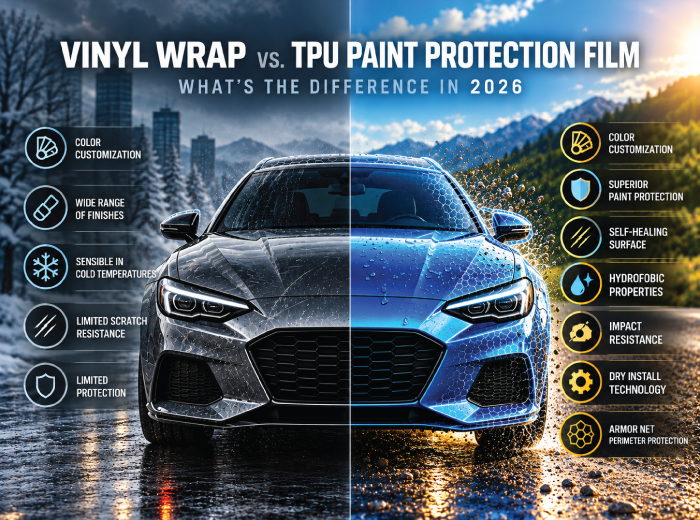
Today, advanced thermoplastic polyurethane (TPU) paint protection films offer another approach: combining the visual transformation of a color wrap with meaningful physical protection for the vehicle’s original paint.
The distinction is important.
Traditional vinyl wraps are primarily designed to change appearance. TPU paint protection films are engineered to provide a protective barrier against road debris, minor impacts, abrasion, and environmental exposure.
For professional installers, another development is making this technology particularly interesting: dry-install TPU PPF with built-in micro air-release channels.
This technology brings familiar dry-wrapping techniques to a material traditionally associated with wet installation.
At ArmorXcell, we believe understanding these differences is essential for both vehicle owners and professional installers considering their next generation of automotive films.
In this article
1. What Is a Traditional Vinyl Wrap?
A traditional automotive vinyl wrap is generally manufactured from polyvinyl chloride (PVC), formulated into a thin, flexible film with an adhesive backing.
Premium cast vinyl films are engineered to conform to vehicle body panels, including curves, contours, and recessed areas.
Their primary purpose is visual customization.
A vinyl wrap can transform a white vehicle into metallic blue, satin black, brushed titanium, or hundreds of other finishes without changing the underlying paint.
Advantages of Traditional Vinyl Wraps
Vinyl wraps remain popular for several good reasons:
- Extensive color and finish selections.
- Established installation techniques and equipment.
- Generally lower material costs than conventional premium PPF.
- Good conformability, particularly with high-quality cast vinyl.
- The ability to change a vehicle’s appearance without repainting.
Modern premium vinyl wraps also offer advanced adhesive systems that support repositioning and air release during installation.
However, vinyl’s main limitation is its relatively modest resistance to physical impacts.
Although it can help protect against light surface wear, conventional color-change vinyl is not designed to provide the same stone-chip and abrasion protection as dedicated TPU paint protection film.
2. What Is TPU Paint Protection Film?
TPU stands for thermoplastic polyurethane, a flexible polymer used in advanced protective film applications.
Unlike conventional PVC color wraps, automotive TPU PPF is engineered primarily around physical protection.
A typical premium TPU paint protection film combines a flexible polyurethane base, a pressure-sensitive adhesive system, and a protective surface coating.
Depending on the formulation, these layers can provide:
- Resistance to stone chips and minor road impacts.
- Protection against scratches and surface abrasion.
- High elasticity and flexibility.
- Resistance to environmental contamination.
- Self-healing of minor surface scratches.
- Long-term retention of appearance.
Clear TPU PPF vs. Colored TPU PPF
Traditionally, paint protection films were predominantly transparent.
Their purpose was to preserve the vehicle’s original paint color while adding an almost invisible protective layer.
Colored TPU PPF expands those possibilities.
It allows vehicle owners to change the appearance of their vehicles while adding the protective characteristics associated with polyurethane film technology.
For example, a white vehicle can receive a metallic blue, satin gray, or high-gloss color finish without sacrificing the protective function of the film.
This combination makes colored TPU PPF an attractive alternative to traditional vinyl wrapping.
A New Development: Dry-Install TPU PPF
Many conventional TPU paint protection films are installed using water-based application solutions. Dry-install TPU PPF takes a different approach. Selected dry-install formulations incorporate specialized adhesive systems and microscopic air-release channels that allow trapped air to escape as pressure is applied during installation. For installers already familiar with dry vinyl wrapping, this can significantly reduce the learning curve. The materials are not identical, and installers must still understand the stretching, heating, adhesive, and finishing requirements of the particular TPU film. However, many of the fundamental techniques are already familiar. This creates an opportunity for professional wrap shops to expand beyond traditional vinyl color changes and offer advanced TPU paint protection films without completely changing their installation workflow.
3. Vinyl Wrap vs. TPU Paint Protection Film — Complete Comparison
| Feature | Traditional Vinyl Wrap | Conventional TPU PPF | ArmorXcell Dry-Install TPU PPF |
|---|---|---|---|
| Primary Purpose | Vehicle color change and customization | Paint protection, usually transparent | Color customization combined with paint protection |
| Base Material | Primarily PVC (polyvinyl chloride) | TPU (thermoplastic polyurethane) | TPU (thermoplastic polyurethane) |
| Stone-Chip & Impact Protection | Limited protection against minor road impacts | Strong protection against stone chips and road debris | Strong protection against stone chips and road debris |
| Scratch Resistance | Moderate; depends on film formulation | High; protective surface coating | High; protective surface coating |
| Self-Healing Properties | Generally not available on conventional vinyl | Available on many premium TPU films | Available on ArmorXcell self-healing film formulations |
| Elasticity & Flexibility | Flexible; heat is often needed for complex curves | Highly elastic; installation behavior varies | Highly elastic; designed for dry application |
| Installation Method | Primarily dry installation | Primarily wet installation | Dry installation |
| Air-Release Technology | Available on many premium vinyl wraps | Generally not used in conventional wet-install PPF | Built-in micro air-release channels |
| Bubble Removal | Air-release channels help remove trapped air | Installation solution helps position film and remove trapped air | Microchannels help trapped air escape under squeegee pressure |
| Repositioning | Possible with many premium adhesive systems | Supported by wet installation solutions | Designed to allow repositioning during dry installation |
| UV & Weather Resistance | Depends on product quality and finish | Generally engineered for long-term outdoor exposure | Designed for long-term outdoor protection |
| Resistance to Fading & Cracking | Varies by vinyl quality and environmental exposure | Generally strong in premium formulations | Designed for resistance to fading and cracking |
| Expected Service Life | Varies considerably; premium vinyl can last several years | Often marketed for approximately 7–10 years or longer | Targeted for long-term service; product-specific durability data should determine published lifespan |
| Color & Finish Options | Extensive selection | Traditionally transparent; colored options increasingly available | Hundreds of available colors and finishes |
| Material Cost | Generally lower than premium TPU PPF | Generally higher than vinyl | Positioned close to leading premium American-branded vinyl films |
| Installation Labor | Established techniques and labor requirements | Wet installation requires specific skills | Familiar dry-wrapping techniques can reduce the transition effort |
| Best Application | Affordable color changes and customization | Long-term paint protection | Color transformation with advanced paint protection |
What Makes TPU PPF Different From Traditional Vinyl?
The fundamental difference is not simply the material itself, but what each film is designed to accomplish. Traditional vinyl wraps focus primarily on appearance. They provide an established, cost-effective way to change a vehicle’s color and finish. TPU paint protection films go further by introducing a protective layer engineered to withstand everyday road hazards, including small stones, surface abrasion, and environmental contamination. Premium TPU formulations can also incorporate self-healing surface coatings that help minor scratches disappear when exposed to warmth. For vehicle owners, this means the possibility of combining a distinctive new appearance with meaningful paint protection. For professional installers, the distinction becomes even more interesting with the development of dry-install TPU PPF.
4. Stone-Chip & Impact Protection: Why TPU PPF Offers More Than a Color Change
The Difference Between Covering Paint and Protecting It
Every time a vehicle travels on the road, its exterior surfaces are exposed to small stones, sand, gravel, and other airborne debris. Highway driving, construction zones, and roads with loose gravel can be particularly demanding on automotive paint. Even relatively small particles can strike painted surfaces at considerable speed, potentially causing chips, scratches, and permanent damage to the original finish. Both traditional vinyl wraps and TPU paint protection films create an additional layer over the paint. However, their ability to manage these impacts can differ significantly.
Traditional Vinyl: Primarily Designed for Appearance
Conventional automotive vinyl wraps are generally thin, flexible PVC-based films designed to conform to vehicle body panels and change their appearance. While vinyl provides a physical barrier that may help prevent light scratches and minor surface wear, it is not primarily engineered to absorb the energy of impacts from stones and road debris. A sufficiently strong impact can penetrate or damage the vinyl and potentially affect the paint underneath. For vehicle owners who prioritize color customization at a relatively affordable price, vinyl remains a practical option. However, when physical paint protection becomes a primary concern, dedicated paint protection film offers important advantages.
TPU PPF: Engineered to Absorb and Distribute Impact Energy
Thermoplastic polyurethane offers a different combination of material properties. Its flexibility, elasticity, and toughness allow properly engineered TPU paint protection films to deform under impact and help distribute some of the force across the protective layer. Rather than simply covering the paint, TPU PPF is designed to act as a protective barrier between the vehicle’s finish and everyday road hazards.
This is particularly valuable for vulnerable areas such as:
- Front bumpers and hoods exposed to road debris.
- Front fenders and wheel arches.
- Side mirrors and lower door panels.
- Rocker panels and areas behind the wheels.
- Other painted surfaces frequently exposed to gravel, sand, and abrasion.
Film thickness, polyurethane formulation, adhesive properties, and surface-coating technology all influence the level of protection. Although no paint protection film can prevent every type of impact damage, quality TPU PPF can substantially reduce the risk of paint chips and surface damage under many everyday driving conditions.
Colored TPU PPF: Protection Without Sacrificing Appearance
Traditionally, vehicle owners often faced a choice between two different products. A colored vinyl wrap could transform the vehicle’s appearance, while transparent paint protection film could help preserve the original paint. Advanced colored TPU PPF brings these functions together.
Vehicle owners can select distinctive colors and finishes while benefiting from the protective characteristics of polyurethane film technology. A metallic blue, satin gray, or high-gloss black TPU PPF can provide a dramatic visual transformation while helping protect the underlying paint against road debris and everyday wear. This combination is especially attractive for owners who want to personalize their vehicles without giving up the benefits of dedicated paint protection.
5. Self-Healing Technology: How TPU PPF Helps Minor Scratches Disappear
A Protective Surface That Can Recover From Minor Scratches
Everyday driving exposes a vehicle’s exterior to more than stone chips and road debris. Automatic car washes, improper cleaning techniques, dust, brushes, and repeated contact with clothing or other objects can gradually create fine scratches and swirl marks. Over time, these small imperfections can reduce the visual quality of a vehicle’s finish, particularly on dark colors and high-gloss surfaces. Traditional vinyl wraps and advanced TPU paint protection films respond differently to this type of surface damage. One of the most significant advantages of many premium TPU PPF products is their self-healing surface technology.
Traditional Vinyl: Surface Scratches Generally Remain
Conventional automotive vinyl wraps are designed primarily for color customization. Although premium vinyl films can offer good surface durability, most traditional color-change wraps do not incorporate the same type of self-healing topcoat commonly found on premium TPU paint protection films. When a conventional vinyl surface becomes scratched, the damage generally remains visible. Minor imperfections may sometimes become less noticeable with careful heating or surface treatment, depending on the material. However, this should not be confused with a dedicated self-healing coating. Repeated cleaning, washing, and environmental exposure can gradually affect the appearance of the vinyl surface.
TPU PPF: How Self-Healing Technology Works
Many advanced TPU paint protection films incorporate a specially engineered protective topcoat designed to recover from minor surface deformation. When light scratches or swirl marks affect this coating, the polymer structure can gradually return toward its original smooth condition. Heat helps accelerate this process. Depending on the specific film formulation, self-healing may occur through exposure to:
- Warm sunlight.
- Moderate ambient temperatures.
- Warm water.
- Controlled heat applied according to the manufacturer’s instructions.
As the coating recovers, fine scratches can become less visible or disappear, helping maintain a smooth and glossy surface.The effectiveness and speed of self-healing depend on the coating chemistry, temperature, scratch depth, and condition of the film.
What Self-Healing Can — and Cannot — Repair
It is important to distinguish between minor surface scratches and deeper physical damage. Self-healing coatings are primarily designed to recover from superficial marks that affect the upper protective layer. They are not intended to repair every type of damage.
Self-healing may help with:
- Fine swirl marks caused by washing.
- Light surface scratches.
- Minor marks from everyday contact.
- Superficial imperfections that do not penetrate the protective coating.
Self-healing generally cannot repair:
- Deep cuts extending through the film.
- Tears or punctures.
- Severe abrasion that removes protective material.
- Damage that reaches the underlying paint.
- Permanent deformation caused by excessive heat or improper installation.
No self-healing film should be described as scratchproof or capable of repairing unlimited damage. Self-healing technology is designed to help the protective topcoat recover from minor surface imperfections, not to restore material that has been cut, torn, or permanently removed.
Why Self-Healing Matters for Colored TPU PPF
Self-healing technology is especially valuable for colored paint protection films because the film’s visible surface becomes part of the vehicle’s appearance.
On high-gloss black, metallic blue, deep red, and other reflective finishes, fine scratches and swirl marks can be particularly noticeable.
A self-healing topcoat can help preserve a smooth, attractive finish by allowing certain superficial marks to recover.
For vehicle owners, this provides an additional benefit beyond protecting the original paint. For professional installers, it creates another meaningful distinction between conventional color-change vinyl and premium TPU PPF.
The ArmorXcell Approach
ArmorXcell offers self-healing TPU PPF formulations designed to combine automotive styling with protective surface technology.
The objective is straightforward: help maintain the appearance of the film while protecting the painted surface beneath it.
A beautiful finish should do more than look good on installation day.
6. Elasticity & Stretch: Why TPU Behaves Differently From Traditional Vinyl
Flexibility Matters — Especially on Modern Vehicle Designs
Modern vehicles feature increasingly complex body shapes. Deep curves, sculpted bumpers, sharp transitions, recessed areas, and aerodynamic surfaces create challenges for any automotive wrapping material. For professional installers, a film’s ability to stretch, conform, and maintain its position is just as important as its appearance. Traditional vinyl wraps and TPU paint protection films approach these challenges through different material technologies. Understanding these differences helps installers select the right material and installation techniques for each application.
Traditional Vinyl: Flexible, but Sensitive to Heat and Tension
Premium automotive vinyl wraps are engineered to conform to curved and complex vehicle surfaces. High-quality cast vinyl can provide excellent flexibility, particularly when used with appropriate heating techniques. However, PVC-based films have characteristic stretching and recovery behavior. When vinyl is stretched, the material develops internal stresses. If those stresses are not properly managed, the film may gradually attempt to recover toward its previous dimensions. This can contribute to lifting, shrinking, or adhesive failure around edges and recessed areas. Professional installers therefore use controlled heating, stretching, and post-heating techniques to help stabilize the material. Correct installation is essential for long-term performance. Vinyl remains highly effective for vehicle customization, but excessive stretching or improper heat management can compromise its durability.
TPU PPF: High Elasticity and Flexible Recovery
Thermoplastic polyurethane offers a different combination of flexibility, toughness, and elastic recovery. Many TPU formulations can stretch substantially while maintaining their structural integrity. This elasticity allows the material to conform to curved surfaces while retaining the protective characteristics expected from paint protection film. Compared with conventional vinyl, TPU PPF can offer several material advantages:
- High flexibility and elongation capacity.
- Strong resistance to tearing under appropriate installation conditions.
- Elastic recovery after temporary deformation.
- Good conformity to curved automotive surfaces.
- The ability to combine flexibility with impact resistance.
These characteristics are particularly useful when protecting bumpers, fenders, mirrors, and other complex exterior components. However, elasticity must be controlled during installation. Excessive stretching can still create tension, distort the film, affect adhesive performance, or cause lifting around edges. A highly elastic material is not automatically easier to install in every situation.
Does TPU PPF Require Heat for Stretching?
One common misconception is that TPU paint protection film never requires heat. In practice, installation requirements depend on the specific film formulation, thickness, adhesive system, ambient temperature, and complexity of the surface. Some TPU films can stretch and conform to moderate curves with little or no additional heating. More complex shapes may still require controlled warmth to improve handling and reduce installation tension. The objective is not to stretch the film as much as possible. Instead, professional installation involves distributing tension carefully, avoiding excessive deformation, and following the manufacturer’s recommended application procedures. This is especially important for colored TPU PPF, where uneven stretching may affect the visual consistency of certain finishes.
Dry-Install TPU PPF: Familiar Techniques, Different Material Behavior
For experienced vinyl wrap installers, transitioning to TPU PPF traditionally meant learning a different application process. Conventional TPU paint protection films are commonly installed using water-based solutions that allow the film to be positioned and adjusted before the adhesive establishes contact. ArmorXcell dry-install TPU PPF introduces another option. Its specialized adhesive system and built-in micro air-release channels support application without conventional wet-installation solutions. This allows installers to work with familiar techniques, including:
- Dry positioning and alignment.
- Controlled stretching around body contours.
- Repositioning during initial application.
- Squeegee pressure to establish adhesive contact.
- Removal of trapped air through integrated microchannels.
The material still requires TPU-specific handling knowledge, particularly regarding stretching limits, heating, edge finishing, and adhesive behavior. Nevertheless, experienced vinyl installers already possess many of the fundamental skills needed to begin working with dry-install TPU PPF.
Why Elasticity Matters for Long-Term Protection
Elasticity is not only an installation characteristic. It also contributes to the protective function of TPU paint protection film. When exposed to minor impacts, a flexible polyurethane layer can deform and help distribute some of the applied force. This behavior contributes to the film’s ability to protect automotive paint against everyday road debris and abrasion. The combination of elasticity, toughness, and protective surface coatings is one reason TPU has become an important material in modern paint protection technology.
7. Dry-Install TPU PPF: How Micro Air-Release Channels Make the Transition From Vinyl Easier
A New Opportunity for Professional Vinyl Wrap Installers
For many years, automotive vinyl wraps and paint protection films have followed two different installation approaches. Traditional color-change vinyl is commonly installed dry, using pressure-sensitive adhesives and specialized air-release technology. Conventional TPU paint protection film, on the other hand, is typically installed using water-based application solutions. These differences have influenced the skills, equipment, and working methods required by professional installation shops. An experienced vinyl installer may already possess excellent knowledge of surface preparation, film positioning, stretching, heating, and edge finishing. However, transitioning to conventional wet-install PPF introduces an additional set of techniques.
Dry-install TPU PPF helps bridge this gap.
By combining a polyurethane protective film with an adhesive system designed for dry application, this technology allows experienced vinyl installers to build on skills they already use every day. For automotive wrap businesses, it creates an opportunity to expand their services beyond appearance customization and into advanced paint protection.
What Are Micro Air-Release Channels?
One of the most important features of dry-install film technology is its ability to manage air trapped between the adhesive and the vehicle’s surface. When a film is applied to a painted panel, small air pockets can develop beneath the material. If trapped air cannot escape, these pockets may remain visible as bubbles and interfere with achieving a smooth finish. Many premium vinyl wraps address this challenge through specially engineered adhesive structures containing microscopic air-release channels. These channels provide pathways through which trapped air can move toward the film’s edges as pressure is applied. ArmorXcell dry-install TPU PPF uses the same general principle. Its adhesive system incorporates built-in micro air-release channels designed to help trapped air escape during application. As the installer works across the surface with a squeegee, the channels facilitate air movement and help reduce visible bubbles. This technology makes dry installation possible without relying on the water-based application solutions commonly used with conventional TPU PPF.
Watch the Technology in Action: Real Installation Test
Video caption: A hands-on demonstration of ArmorXcell dry-install TPU PPF. Watch how visible air pockets are smoothed out using squeegee pressure, demonstrating the film’s built-in micro air-release technology.
In this demonstration, air pockets are intentionally left beneath a sample of ArmorXcell dry-install TPU paint protection film. As pressure is applied with a squeegee, the trapped air escapes and the visible bubbles disappear. The demonstration highlights one of the practical benefits of this adhesive technology: installers can remove trapped air using techniques already familiar from traditional vinyl wrapping. The video shows actual material behavior during a hands-on test, rather than a computer-generated simulation. Results may vary depending on surface preparation, application pressure, film positioning, temperature, and the size of the trapped air pockets.
Dry Installation vs. Wet Installation: What’s the Difference?
Both installation methods have advantages, and neither should be considered universally superior for every product or application.
Conventional Wet-Install TPU PPF
Wet installation typically involves applying a water-based solution between the film’s adhesive and the painted surface. This solution temporarily reduces adhesive contact, allowing the installer to position and adjust the film. The installer then uses a squeegee to remove the solution and trapped air, gradually establishing adhesive contact with the vehicle. Wet installation remains an established and effective method for many professional paint protection film applications. However, it requires knowledge of solution preparation, moisture management, film positioning, and appropriate adhesive activation.
ArmorXcell Dry-Install TPU PPF
Dry installation eliminates the need for conventional slip solutions during application. Instead, the film is positioned directly onto the prepared surface. Its specialized adhesive system supports initial positioning, while integrated micro air-release channels help remove trapped air as pressure is applied. For experienced vinyl installers, the general workflow is familiar. The installer can concentrate on film alignment, controlled stretching, squeegee technique, and finishing without introducing a completely different wet-application process. Dry installation also avoids the need to manage application liquid beneath the film. However, installers must still follow the product’s specific instructions regarding repositioning, stretching, temperature, and adhesive contact.
Why This Matters for Existing Vinyl Wrap Businesses
Professional wrap shops have already invested significant time and resources into developing installation expertise. Their technicians understand how to work around vehicle contours, manage film tension, and achieve clean finishes. Transitioning to conventional wet-install PPF can require additional training and changes to established workflows. Dry-install TPU PPF offers an alternative. Instead of starting from an entirely unfamiliar application method, experienced vinyl installers can adapt existing techniques to a protective polyurethane film.
Potential benefits include:
- Familiar installation methods: Many positioning, squeegee, and finishing techniques carry over from vinyl wrapping.
- No conventional wet-installation solutions: Application does not require the slip solutions commonly used for wet-install PPF.
- Easier air management: Integrated microchannels help trapped air escape under pressure.
- An opportunity to expand services: Wrap shops can introduce colored TPU PPF alongside traditional vinyl offerings.
- Additional value for customers: Vehicle owners can combine color customization with the protective characteristics of TPU.
These benefits do not eliminate the need for product-specific training. TPU and PVC vinyl have different mechanical properties, adhesive characteristics, and handling requirements. Nevertheless, dry-install technology can make the transition more accessible for experienced wrap professionals.
Is Dry-Install TPU PPF Exactly Like Installing Vinyl?
Not entirely. Although the installation methods share important similarities, TPU paint protection film is a different material. Its elasticity, thickness, surface coating, and adhesive behavior may differ from those of conventional cast vinyl. Installers should pay particular attention to:
Stretching and tension: TPU can behave differently when stretched around complex body contours. Excessive tension should be avoided.
Temperature management: Heating requirements depend on the specific film and installation conditions.
Repositioning: The ability to lift and reposition the film depends on the adhesive formulation and the amount of pressure already applied.
Edge finishing: Correct edge preparation and finishing remain essential for long-term adhesion.
Surface preparation: As with vinyl, the vehicle’s surface must be thoroughly cleaned and prepared before application.
The objective is not to suggest that vinyl and TPU are interchangeable. Rather, the advantage is that dry-install TPU PPF allows experienced installers to approach a new protective material using a familiar application process.
ArmorXcell: Helping Wrap Installers Move Beyond Vinyl
At ArmorXcell, we see dry-install TPU PPF as an important development for the automotive wrapping industry. Traditional vinyl will continue to serve customers who prioritize color changes, graphic customization, and lower material costs. But for customers seeking a combination of distinctive appearance and advanced paint protection, colored TPU PPF offers additional functionality. ArmorXcell’s dry-install technology makes that opportunity more accessible to professional installers already working with vinyl. With built-in micro air-release channels and a dry-application adhesive system, experienced wrap professionals can expand into TPU paint protection film without abandoning their established installation techniques.
Familiar installation. Easier transition. Advanced paint protection. The next generation of automotive color wraps is not just about changing how a vehicle looks.
It’s about changing how a vehicle looks while helping protect the paint underneath.
8. Durability & Lifespan: How Long Do Vinyl Wraps and TPU PPF Really Last?
Why the Initial Appearance Doesn’t Tell the Whole Story
A newly installed vinyl wrap and a premium colored TPU paint protection film can look remarkably similar. Both can deliver vibrant colors, deep gloss, metallic effects, and sophisticated satin finishes. However, the differences between these materials often become more noticeable after months or years of exposure to sunlight, temperature changes, road debris, washing, and everyday driving. For vehicle owners, the important question is not simply how the film looks immediately after installation.
How well will it maintain its appearance and protective properties over time?
The answer depends on the film’s construction, surface coating, environmental conditions, maintenance, and installation quality.
Traditional Vinyl Wrap: Durability Depends on Film Quality
Modern automotive vinyl wraps have improved significantly. Premium cast vinyl films from established manufacturers can provide several years of outdoor service when properly installed and maintained. Some premium products are supported by manufacturer warranty periods extending to approximately five to eight years for qualifying applications. However, actual service life can vary considerably.
Important factors include:
- Sunlight and UV exposure: Prolonged exposure can gradually affect color stability and surface appearance.
- High temperatures: Repeated heating may contribute to material aging and adhesive stress.
- Cold temperatures: PVC-based films can become less flexible in cold conditions, increasing the risk of cracking or damage during handling or deformation.
- Horizontal surfaces: Hoods, roofs, and trunk lids often experience greater solar exposure than vertical panels.
- Film finish: Matte, satin, metallic, chrome, and other specialty finishes may have different durability characteristics.
- Installation quality: Excessive stretching, inadequate post-heating, and poor edge preparation can reduce service life.
- Maintenance: Harsh chemicals, abrasive cleaning, and improper washing can accelerate surface deterioration.
It is important to distinguish between a manufacturer’s published durability rating, its warranty coverage, and the actual lifespan experienced by a vehicle owner. These are not necessarily the same. A well-maintained premium vinyl wrap may perform for many years, while lower-quality films or installations exposed to severe conditions may deteriorate much sooner.
TPU Paint Protection Film: Designed for Long-Term Surface Protection
Premium TPU paint protection films are engineered with a different primary objective. Beyond maintaining appearance, they are designed to provide a protective barrier against stone chips, surface abrasion, and environmental exposure. Many premium TPU PPF products incorporate advanced topcoats intended to improve resistance to staining, surface wear, and weathering. Selected formulations also provide self-healing properties that help minor scratches recover. Together, these characteristics can support long-term appearance retention and paint protection. Established premium PPF manufacturers offer products with limited warranties of approximately ten years, although coverage varies by product and manufacturer. This does not mean that every TPU film will perform for ten years or that warranty coverage guarantees identical results under all conditions. Film construction, topcoat chemistry, installation, maintenance, and climate remain critical.
What About Colored TPU PPF?
Colored TPU PPF combines the protective characteristics of polyurethane film with the visual customization traditionally associated with vinyl wraps. However, colored TPU films introduce additional considerations. Beyond maintaining the integrity of the protective layer, the film must preserve its color, finish, and visual consistency. Color stability can depend on the pigments, manufacturing process, surface coating, and exposure conditions. For example, a high-gloss metallic finish may respond differently to long-term sunlight exposure than a solid satin color. For this reason, durability claims for colored TPU PPF should be based on the specific product’s technical specifications and testing rather than assumptions about TPU as a material category.
Florida Sun, Heat, and Humidity: A Real-World Durability Challenge
In South Florida, automotive films face particularly demanding environmental conditions. Strong sunlight, high surface temperatures, humidity, heavy rain, and frequent exposure to airborne contaminants can accelerate the aging of exterior materials. Vehicles parked outdoors for extended periods may experience substantial temperature changes across their body panels. Dark-colored surfaces can become especially hot under direct sunlight. These conditions make material quality and proper installation particularly important. A premium protective film should be evaluated not only for its appearance but also for its resistance to weathering, adhesive stability, and ability to maintain its protective surface over time. For both vinyl and TPU PPF, correct washing procedures and appropriate maintenance products can help preserve appearance and performance.
Durability vs. Warranty: Understanding the Difference
A manufacturer’s warranty is an important consideration, but it should not be confused with a guaranteed service life.
Warranty terms may vary depending on:
- Product type and finish.
- Geographic location.
- Horizontal or vertical installation.
- Commercial or personal vehicle use.
- Approved installation procedures.
- Maintenance requirements.
- Specific exclusions and limitations.
A ten-year limited warranty does not mean that a film is immune to scratches, impacts, discoloration, or environmental damage. Similarly, a film without a published ten-year warranty is not necessarily incapable of providing long-term service. The most reliable approach is to examine the manufacturer’s technical data, warranty conditions, and relevant performance testing.
The Long-Term Value of TPU Paint Protection Film
When comparing vinyl and TPU PPF, material price is only one part of the equation. A traditional vinyl wrap may provide excellent visual customization, but its primary function is not impact protection. If road debris damages the underlying paint, the vehicle owner may face additional repair costs. TPU PPF is designed to reduce the risk of certain types of paint damage while maintaining the vehicle’s appearance. Premium formulations may also offer self-healing surface coatings and hydrophobic properties that make routine maintenance easier. These additional functions can create value throughout the film’s service life. However, the financial benefit depends on the specific products being compared, installation costs, vehicle use, and actual performance.
The Bottom Line
Traditional vinyl wraps remain an effective solution for automotive customization, particularly when appearance, graphics, and established installation methods are the main priorities. Premium TPU paint protection films offer a different value proposition. They combine visual appearance with physical protection, and selected formulations provide self-healing coatings, hydrophobic surfaces, and enhanced resistance to everyday road hazards. ArmorXcell dry-install TPU PPF adds the convenience of an application process familiar to experienced vinyl wrap professionals. Ultimately, long-term performance depends on choosing the right product, installing it correctly, and maintaining it appropriately.
A great finish changes how your vehicle looks today. A quality protective film is designed to help preserve that appearance for years to come.
9. Vinyl Wrap vs. TPU PPF Pricing: Is Advanced Paint Protection Really More Expensive?
The Traditional Price Difference Between Vinyl and TPU PPF
For many years, one of the main reasons vehicle owners selected traditional vinyl wraps instead of colored paint protection films was price. Vinyl wrapping became popular because it offered a relatively affordable way to change a vehicle’s appearance without repainting it. Premium TPU paint protection films, meanwhile, were primarily marketed as high-end protective products. Their more complex material construction, protective coatings, and specialized installation requirements generally contributed to higher costs. As a result, many customers developed a simple assumption:
Vinyl is for changing color. TPU PPF is for expensive paint protection.
While this distinction still reflects parts of the automotive film market, advances in materials, manufacturing, and installation technology are creating new alternatives. Today, selected colored TPU PPF products can offer competitive material pricing while combining visual customization with advanced paint protection.
Material Cost vs. Installation Cost: Understanding the Difference
When comparing vinyl wraps and TPU paint protection films, it is important to distinguish between two major expenses.
1. Material Cost
Material cost refers to the price of the film itself. This depends on several factors, including:
- Base material and film construction.
- Manufacturer and brand positioning.
- Film thickness and protective coating.
- Adhesive technology.
- Color, finish, and special effects.
- Roll dimensions and purchase quantities.
- Distribution and import costs.
Premium cast vinyl films can be considerably more expensive than entry-level vinyl products. Similarly, TPU paint protection films vary widely in price depending on their formulation, quality, and intended application. Therefore, comparing the cheapest vinyl with the most expensive TPU PPF does not provide a meaningful picture of the available alternatives. A more useful comparison is between products intended for similar customers and professional applications.
2. Installation Cost
Installation labor is another major component of the final price. Professional vehicle wrapping requires careful preparation, accurate positioning, controlled stretching, precise cutting, and detailed finishing. Traditional vinyl installers typically use dry-application techniques developed specifically for automotive wrapping films. Conventional TPU PPF often requires wet installation, introducing additional procedures involving application solutions, moisture removal, and adhesive management. These differences can influence installation time, training requirements, and labor costs. However, wet installation is not inherently more expensive in every situation, and dry installation does not automatically guarantee faster completion. The actual labor cost depends on the installer’s experience, the film’s handling characteristics, vehicle complexity, and required finish quality.
How Dry-Install TPU PPF Changes the Equation
ArmorXcell dry-install TPU PPF introduces an important consideration when comparing installation costs. Its integrated micro air-release channels allow experienced vinyl installers to use familiar dry-application techniques rather than conventional wet-installation solutions. Although TPU requires product-specific handling knowledge, this technology can reduce some of the workflow changes associated with entering the PPF market. Actual installation costs will still depend on vehicle complexity, film characteristics, and installer experience.
Familiar installation methods can help make advanced TPU technology more practical for existing wrap businesses.
ArmorXcell: TPU PPF Pricing Closer to Premium Vinyl
ArmorXcell approaches the market with a different pricing philosophy. Rather than positioning colored TPU paint protection film exclusively as a high-priced luxury product, ArmorXcell aims to make advanced protective films accessible to a broader range of professional installers and vehicle owners. Our dry-install colored TPU PPF is positioned at a material price relatively close to leading premium American-branded vinyl wraps. This is an important distinction. When the difference in material cost becomes relatively small, customers can evaluate the additional protective benefits of TPU rather than rejecting it based on assumptions about price.
Depending on the selected product, these benefits may include:
- Improved resistance to stone chips and road debris.
- Self-healing of minor surface scratches.
- Hydrophobic surface properties.
- High elasticity and flexibility.
- A protective barrier over the vehicle’s original paint.
- A wide selection of automotive colors and finishes.
ArmorXcell’s dry-install technology adds another practical advantage for professional wrap shops. By incorporating micro air-release channels, the film supports familiar dry-application methods, helping installers transition from conventional vinyl without completely changing their established workflow. This combination of competitive material pricing, protective functionality, and familiar installation techniques creates a compelling alternative to traditional color-change vinyl.
Is TPU PPF Always the Better Financial Choice?
Not necessarily. The right choice depends on the customer’s priorities, intended vehicle use, and expectations. Traditional vinyl remains an attractive option for temporary color changes, promotional graphics, commercial branding, and customers who prioritize appearance over physical paint protection. For these applications, premium vinyl can be an excellent solution. However, when customers want both a new color and meaningful protection for the underlying paint, colored TPU PPF deserves consideration. A higher initial investment may be justified if the film helps reduce paint damage and maintain the vehicle’s appearance over time. The potential financial benefits depend on actual product performance, installation costs, maintenance, and the vehicle’s exposure to road hazards. Neither film should be viewed as a guaranteed way to increase resale value or eliminate future paint repair expenses.
Comparing the Total Value, Not Just the Initial Price
Imagine two vehicle owners choosing between traditional vinyl and colored TPU PPF. Both want to transform their vehicles from white to a premium metallic blue finish. The first owner selects conventional vinyl primarily for its visual appearance. The second selects colored TPU PPF because they also want protection against everyday road debris and minor surface scratches. Initially, both vehicles may look very similar. Over time, however, their owners may experience different levels of protection, surface wear, and maintenance requirements. The TPU PPF owner may benefit from additional impact resistance, self-healing surface technology, and hydrophobic properties, depending on the specific film formulation. These differences can influence the long-term value of the installation.
The key question is not simply:
Which film costs less today?
A more useful question is:
What am I receiving for the total amount invested?
A New Opportunity for Professional Wrap Installers
Competitive TPU PPF pricing also creates opportunities for automotive wrapping businesses. Professional installers can offer customers a choice between traditional appearance-focused vinyl and advanced protective color films. Rather than competing exclusively on the price of a color change, wrap shops can introduce a product with additional functional benefits. For experienced vinyl installers, ArmorXcell dry-install TPU PPF makes this opportunity especially relevant. The film combines protective polyurethane technology with an application method that builds on existing dry-wrapping skills. This allows businesses to explore a higher-value product category without abandoning the installation experience they have already developed.
The Bottom Line: Advanced Protection Is Becoming More Accessible
Traditional vinyl wrapping continues to offer excellent customization possibilities. However, the automotive film industry is evolving beyond the idea that changing a vehicle’s appearance and protecting its paint must be two separate objectives. Colored TPU paint protection films bring these functions together. ArmorXcell’s competitive material pricing and dry-installation technology are designed to make that combination more accessible to professional installers and their customers. When the material price difference is relatively small, the additional protective characteristics of TPU become an important consideration.
The future of automotive color customization is not simply about offering more colors. It’s about offering more value with every color.
10. Which Should You Choose: Vinyl Wrap or TPU PPF?
The Right Choice Depends on What You Expect From Your Vehicle Wrap
Traditional vinyl wraps and TPU paint protection films serve different purposes, even though both can dramatically transform a vehicle’s appearance. Vinyl remains an established solution for automotive customization, offering extensive color selections, specialty finishes, and proven installation techniques. Colored TPU PPF introduces another possibility: changing the vehicle’s appearance while adding a protective barrier over its original paint. Neither material is automatically the right choice for every vehicle or every customer. The decision should be based on how the vehicle will be used, the level of protection required, the desired appearance, and the overall installation budget.
When Traditional Vinyl Wrap Is a Good Choice
Traditional vinyl may be the better option when:
- Appearance is the primary objective. The customer wants a different color or finish without requiring substantial impact protection.
- The design involves printed graphics. Commercial branding, advertising wraps, and detailed custom graphics are well-established vinyl applications.
- The installation is temporary. The vehicle may require frequent design changes or short-term promotional graphics.
- A particular specialty finish is required. Some textures, printed effects, and decorative finishes may be available only in vinyl.
- The customer prefers an established installation solution. Professional vinyl wraps have a long history of successful automotive applications.
Premium cast vinyl remains a capable material when selected and installed for its intended purpose. However, customers should understand that conventional color-change vinyl is not designed to provide the same level of physical paint protection as dedicated TPU PPF.
When Colored TPU PPF Is the Better Choice
Colored TPU paint protection film becomes particularly attractive when the customer wants both appearance customization and meaningful paint protection.
Consider TPU PPF when:
- Paint protection matters. The vehicle is regularly exposed to highways, gravel, road debris, or other conditions that increase the risk of stone chips.
- Long-term appearance is a priority. Premium protective coatings can help maintain the film’s surface condition.
- Self-healing is desirable. Selected TPU formulations allow minor surface scratches and swirl marks to recover.
- Hydrophobic properties are important. Water-repellent coatings can help water bead and roll off the surface, making routine cleaning more convenient.
- The original paint should be preserved. A properly installed protective film helps reduce direct exposure to certain everyday hazards.
- The customer wants more functionality from a color change. Colored TPU PPF combines customization with protective material technology.
For vehicle owners planning to keep their cars for several years, these additional benefits may justify choosing TPU PPF over conventional vinyl.
What About Professional Vinyl Wrap Installers?
For professional installers, the decision involves more than material performance. It also includes installation techniques, training, workflow, and the ability to meet changing customer expectations. Traditional vinyl remains an important part of the automotive customization industry. However, colored TPU PPF creates an opportunity to offer customers additional protection without sacrificing the visual appeal of a color wrap. Historically, transitioning from dry-installed vinyl to conventional wet-installed PPF required learning a substantially different application process.
Dry-install TPU PPF changes that equation.
ArmorXcell dry-install TPU PPF incorporates built-in micro air-release channels that help trapped air escape during application. Experienced vinyl installers can build on familiar techniques, including dry positioning, controlled stretching, squeegee pressure, and careful edge finishing. Although TPU requires product-specific handling knowledge, this approach can make the transition more accessible. For wrap businesses, it provides an opportunity to expand their product offerings while building on existing installation expertise.
Final Thoughts: Beyond Vinyl
Choosing between traditional vinyl and TPU paint protection film is ultimately about priorities. If the goal is primarily a visual transformation, premium vinyl remains an excellent option. If the goal is to transform a vehicle’s appearance while helping protect its original paint, colored TPU PPF offers meaningful additional benefits. ArmorXcell dry-install TPU PPF brings these possibilities together through protective polyurethane technology, integrated micro air-release channels, and competitive material pricing.
The colors you love. The protection traditional vinyl can’t match.
Discover ArmorXcell Dry-Install TPU Paint Protection Film
Are you a professional vinyl wrap installer interested in expanding into colored TPU paint protection film? Explore ArmorXcell’s advanced dry-install technology, available colors and finishes, and opportunities for professional installers and distributors.
Go beyond traditional vinyl. Discover ArmorXcell TPU PPF.