
ArmorXcell EPU-2090 — Premium Black Rear Windshield Protection Film
Transform the rear of your vehicle with a seamless black appearance, enhanced privacy, and advanced exterior glass protection.
A premium automotive finish is defined by more than paint color. The relationship between body panels, glass, roof surfaces, trim, and reflections determines whether a vehicle looks ordinary or carefully designed.
ArmorXcell EPU-2090 introduces a different approach to automotive window styling. Instead of treating the rear windshield as a separate piece of glass, it helps integrate the window into the vehicle’s overall exterior design.
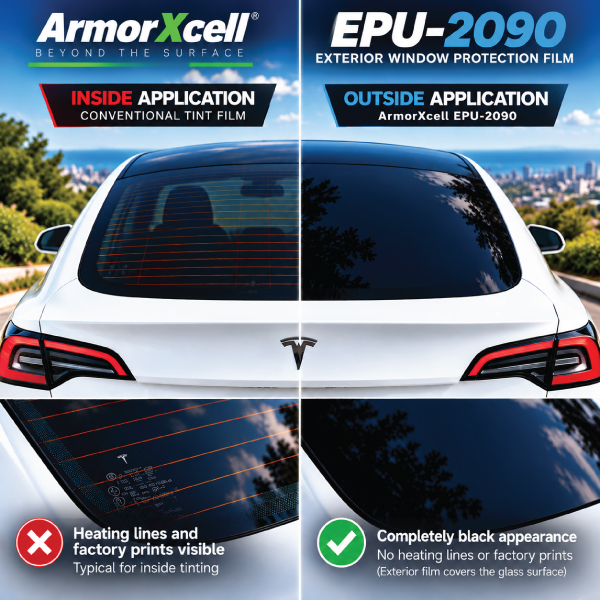
With 20% visible light transmission (VLT), EPU-2090 creates a deep, dark appearance that can visually conceal rear defroster lines, reduce the visibility of factory glass markings, and give the rear window a smooth, glossy finish.
Applied to the exterior surface of automotive glass, EPU-2090 combines visual transformation with protective film technology.
Its primary applications are rear windshields and rear side windows. The film can also be used on compatible panoramic glass roofs.
1. A Clean Black Rear Windshield — Without Distracting Heating Lines
<text color=”secondary” italic>From visible glass details to a refined, uninterrupted appearance.</text>
One of the most noticeable differences between conventional interior tint and exterior EPU protection film is the appearance of the rear windshield when viewed from outside.
Most automotive rear windshields contain electrically conductive defroster lines. These horizontal heating elements are essential for removing condensation and frost, but they can remain visible through conventional interior window tint.
Rear glass may also contain factory markings, ceramic printing, antenna elements, or other manufacturing details that interrupt its appearance.
Traditional interior tint is installed behind the glass. Consequently, these elements remain between the viewer and the tinted film, making them potentially visible from outside.
EPU-2090 is applied to the outer surface of the glass.
This placement creates a dark, uniform film surface in front of the internal heating elements and many factory details.
The result can be a substantially cleaner black appearance, with defroster lines and certain markings becoming difficult or impossible to distinguish under suitable viewing conditions.
Instead of drawing attention to the construction of the rear windshield, the glass becomes a cohesive part of the vehicle’s exterior design.
For owners who appreciate minimalism, smooth reflections, and carefully coordinated surfaces, this visual difference can be significant.
The actual degree of concealment depends on glass construction, lighting, viewing angle, and installation quality. Defroster elements remain physically present and functional, subject to vehicle compatibility.
2. The Black Roof Effect — One Continuous Visual Surface
<text color=”secondary” italic>Connect the roof and rear windshield into a unified design.</text>
Modern automotive design increasingly uses contrasting roof colors, black panoramic glass, and dark upper-body elements to create a lower, more streamlined visual profile.
Many vehicles already feature black panoramic roofs or black-painted roof sections. However, the rear windshield may still look visually separate because of its lighter appearance, visible defroster lines, or contrasting reflections.
EPU-2090 can help bridge this visual gap.
When the rear windshield is finished in deep black and the roof is already black, the two surfaces can appear to flow together.
From behind, the roof and rear glass can visually merge into one continuous glossy black area.
This effect can make the upper section of the vehicle appear more integrated, elegant, and intentionally designed.
It is particularly attractive on vehicles with sloping rear glass, fastback profiles, hatchback designs, and panoramic roofs.
The styling concept is not limited to Tesla. It can be explored on compatible vehicles from BMW, Mercedes-Benz, Audi, Porsche, Toyota, Hyundai, Kia, and many other manufacturers.
The result depends on the original body shape, roof construction, trim colors, and glass geometry.
For some vehicles, a dark rear windshield is a relatively small change that can create a surprisingly substantial visual improvement.
3. Enhanced Rear-Cabin Privacy
<text color=”secondary” italic>Make the interior less visible from outside.</text>
Privacy is another important reason to consider EPU-2090.
With a manufacturer-reported VLT of 20%, the film allows substantially less visible light through than a clear exterior protection film.
When applied to the rear windshield, it can reduce how easily people outside the vehicle see into the rear cabin.
The effect becomes more coordinated when EPU-2090 is also installed on compatible rear side windows.
Together, the darker rear windshield and rear side glass create a more consistent privacy-oriented appearance around the rear passenger compartment.
This can help reduce casual visibility of rear seats, interior details, and belongings, particularly in bright daytime conditions.
Privacy is not absolute. Interior visibility changes with lighting, viewing angle, existing factory glass tint, and whether the vehicle’s interior lights are on.
A dark window should never be considered a security measure that guarantees valuables cannot be seen.
Nevertheless, EPU-2090 offers a practical combination of reduced interior visibility and exterior styling.
4. A More Premium and Distinctive Vehicle Appearance
<text color=”secondary” italic>Small visual changes can transform the perception of an entire vehicle.</text>
Luxury automotive design frequently emphasizes coordinated surfaces, consistent color transitions, and carefully controlled contrasts.
A glossy black rear windshield can contribute to this effect by removing some of the visual interruptions normally present in automotive glass.
When combined with dark rear side windows, black trim, and a black roof, the rear of the vehicle can acquire a more unified and sophisticated appearance.
The design becomes less fragmented. Instead of separate visual elements competing for attention, the glass and upper body work together.
This is particularly appealing for owners who want a customized appearance without changing the original body paint.
EPU-2090 is not a paint replacement or a body wrap. It is an exterior glass protection film that can complement broader automotive styling projects.
Its value lies in making the glass itself part of the overall design.
5. Combine EPU-2090 With Chrome Delete and Partial Vehicle Wraps
<text color=”secondary” italic>Build a coordinated exterior appearance across glass, paint, and trim.</text>
One of the most interesting opportunities for EPU-2090 is its combination with other exterior customization techniques.
Chrome Delete — A Modern Black Trim Finish
Chrome delete, sometimes called anti-chrome, is a popular styling modification that replaces the appearance of bright chrome trim with black or another coordinated finish.
Black window surrounds, door trim, mirror details, and other accents can create a cleaner exterior appearance.
When EPU-2090 is combined with blacked-out trim and a dark roof, the vehicle’s upper section can appear more consistent and refined.
The film helps connect the glass surfaces visually with surrounding black elements.
Two-Tone Styling — Black Top, Contrasting Body
Another increasingly recognizable automotive design approach combines a black upper section with a contrasting body color.
Examples include a glossy black roof above white, silver, red, blue, or other painted body panels.
Some manufacturers offer contrasting roof colors as factory styling options, while aftermarket wraps make similar visual concepts possible on other vehicles.
EPU-2090 can complement this approach by darkening the rear windshield to visually connect it with the black roof.
A coordinated design may include:
- A black roof or panoramic glass roof.
- A deep-black rear windshield using EPU-2090.
- Dark rear side windows.
- Black window trim and chrome-delete accents.
- Contrasting body paint or a colored TPU paint protection film.
The goal is not simply to make every surface black. It is to create an intentional relationship between the upper and lower sections of the vehicle.
Color TPU PPF and Exterior Glass Protection
ArmorXcell also offers colored TPU paint protection films for compatible painted automotive surfaces.
This creates opportunities to coordinate EPU-2090 exterior glass film with paint protection and color styling.
For example, a white vehicle with a black roof and dark rear glass can achieve a strong monochrome contrast.
A metallic blue or silver vehicle may benefit from a similar black upper section, while more expressive body colors can create a distinctive two-tone appearance.
The glass film and paint protection film perform different functions, but they can contribute to one cohesive design.
6. Exterior Protection — More Than Conventional Window Tint
Appearance is a major reason to choose EPU-2090, but it is not the only consideration.
Unlike conventional interior tint, EPU-2090 is installed on the exterior surface of compatible automotive glass.
This places an additional film layer between the glass and everyday environmental exposure.
The film is designed to help protect the underlying surface against certain minor scratches, light abrasion, and routine environmental contact.
Exterior protection is especially relevant to rear windshields, which may be exposed to dust, road contamination, cleaning equipment, and, on some vehicles, rear windshield wipers.
However, exterior film does not make glass unbreakable or guarantee resistance against stone impacts, hail, or deliberate damage.
Compatibility with rear wipers, seals, heating systems, antennas, and other glass components should be verified before installation.
7. Self-Healing EPU Surface Technology
EPU-2090 belongs to a generation of exterior films promoted by the manufacturer for scratch resistance and surface-recovery properties.
The self-healing concept is intended to allow certain superficial scratches or surface marks to diminish under suitable conditions.
This can help maintain the visual quality of the film during ordinary use.
Self-healing should not be confused with unlimited scratch resistance.
Deep scratches, cuts, punctures, or damage extending through the protective layer may remain visible and require film replacement.
The effectiveness of recovery depends on the type and severity of damage, temperature, and material properties.
For a film intended to create a premium glossy appearance, maintaining a smooth surface is an important consideration.
8. UV and Infrared Rejection
EPU-2090 also provides manufacturer-reported solar-control performance.
Ultraviolet rejection: 99%.
UV rejection helps reduce ultraviolet radiation passing through treated automotive glass and may contribute to protecting interior materials from UV-related deterioration.
Infrared rejection at 950 nm: 93%.
Infrared rejection at 1400 nm: 95%.
These values describe rejection at specific infrared wavelengths.
They should not be interpreted as 93–95% total solar heat rejection.
Actual vehicle temperature reduction depends on the entire solar spectrum, the vehicle’s glass construction, the amount of exposed glass, and environmental conditions.
The film’s 20% VLT also reduces visible light transmission, which can contribute to a darker appearance and reduced visible-light entry.
9. Especificaciones técnicas
| Propiedad | Valor declarado por el fabricante |
|---|---|
| Producto | ArmorXcell EPU-2090 |
| Tecnología de materiales | EPU |
| Instalación | Cristales exteriores del automóvil |
| Aplicación principal | parabrisas trasero |
| Aplicación secundaria | Ventanas laterales traseras |
| Solicitud adicional | Techos panorámicos de cristal compatibles |
| Transmisión de luz visible (VLT) | 20% |
| Rechazo de rayos UV | 99% |
| Rechazo de infrarrojos a 950 nm | 93% |
| Rechazo de infrarrojos a 1400 nm | 95% |
| Turbidez óptica (haze) | 0.4 |
| Aplicación en el parabrisas delantero | No fue intencional |
Las especificaciones las proporciona el fabricante. El valor de turbidez indicado no especifica la unidad de medida. El rendimiento tras la instalación depende de las características del vidrio y de las condiciones de aplicación.
10. Instalación profesional y compatibilidad con vehículos
La lámina EPU-2090 debe ser instalada por profesionales familiarizados con las láminas para ventanas exteriores de automóviles.
El diseño de la luneta trasera varía considerablemente entre los distintos vehículos. Algunos incorporan rejillas desempañadoras, antenas, sistemas de limpiaparabrisas, recubrimientos de fábrica o una construcción de vidrio especializada.
Antes de la instalación, verifique:
- Compatibilidad con el parabrisas trasero y los cristales laterales traseros del vehículo.
- Normativa aplicable sobre tintado de lunas y visibilidad.
- Requisitos de adhesión de la película exterior y acabado de bordes.
- Compatibilidad con limpiaparabrisas traseros y mecanismos de ventanillas laterales móviles.
- Recomendaciones del fabricante para la limpieza y el mantenimiento a largo plazo.
Debido a que EPU-2090 tiene una transmitancia de luz visible (VLT) de 20%, la transmisión final de luz visible de la combinación de vidrio y película puede ser inferior a 20%.
Antes de la instalación, deben consultarse las normativas específicas del vehículo.
11. ¿Por qué elegir ArmorXcell EPU-2090?
El EPU-2090 ofrece una combinación inusual de estilo automotriz y protección para los cristales exteriores.
Su característica distintiva no es simplemente un cristal más oscuro. Es la oportunidad de transformar la relación entre el parabrisas trasero, el techo, las ventanillas laterales y la carrocería circundante.
Un parabrisas trasero más limpio, una línea de techo negra visualmente continua, una mayor privacidad en la cabina trasera y la compatibilidad con conceptos de diseño modernos pueden ayudar a crear una apariencia premium distintiva.
Para los propietarios que aprecian un diseño coordinado, EPU-2090 ofrece una manera de integrar el cristal del automóvil en la identidad visual general del vehículo.
ArmorXcell EPU-2090: Un acabado negro continuo. Más allá de la superficie.
Para consultas sobre disponibilidad de productos, distribución o instalación profesional, póngase en contacto con ArmorXcell.
ArmorXcell suministra láminas protectoras para automóviles. Los servicios de instalación y la compatibilidad con el vehículo deben ser confirmados por un profesional cualificado.
Valoraciones
No hay valoraciones aún.